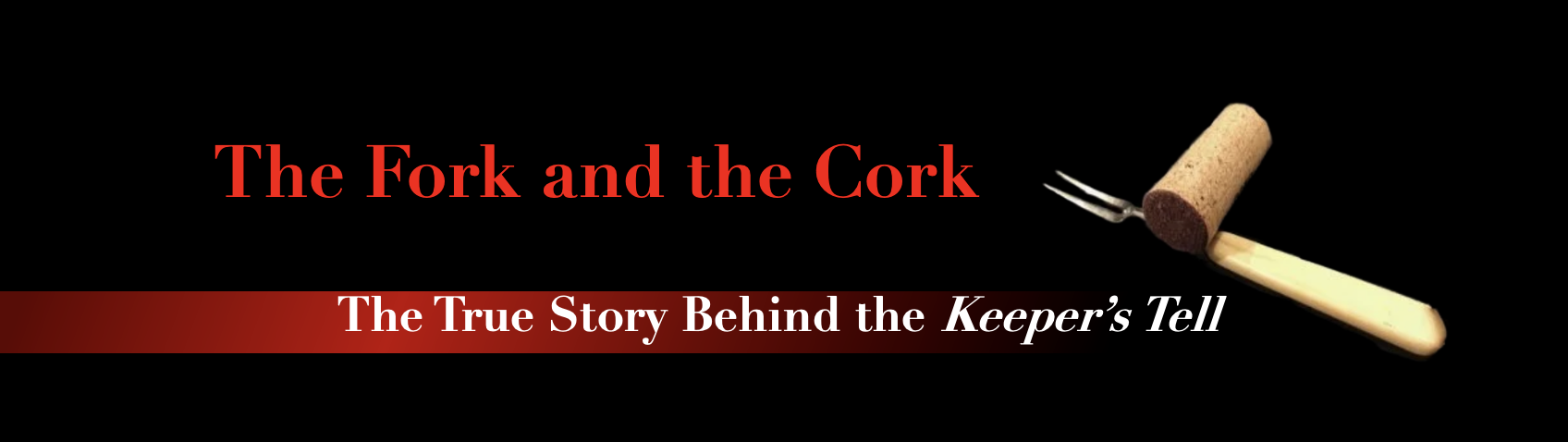
An aging mother. A stolen serving fork. A forgotten first love. Over three days in East Texas, I discovered that the story I had been telling myself about my childhood for nearly sixty years might not have been true. The questions raised during that visit eventually became the novel The Keeper's Tell.
“Did I ever tell you the difference between a bird and a fish?"
My eighty-seven-year-old mother asked me that question after I confronted her about a piece of stolen silverware my father had brought home from World War II.
For most of my life, I believed my childhood had been shaped by two losses that arrived almost at the same time. One was the collapse of my parents' marriage. The other was an eleven-year-old girl, whom I will call Sadie, whose parting words haunted me far longer than either of us could have imagined.
The serving fork had survived a world war, crossed an ocean, endured a divorce, and somehow escaped a garage sale. For years, I had imagined returning it to the family from whom my father had taken it during World War II. My mother had other ideas.
In 2016, shortly after my retirement, I spent several days with my mother and older sister sorting through photographs, reliving family stories, and arguing with memory. What began as a nostalgic trip into the past became something else entirely. Old pictures unearthed forgotten heartbreaks, uncomfortable truths, long-buried family secrets, and a lesson about memory that neither age nor time had taught me.
Over three days, I came to question not only what happened during my childhood, but who has the right to own the meaning of those events. The answers involved a serving fork, a wine cork, a school bus, and a young woman whose influence had lingered far longer than our brief time together.
None of those things seemed related at the time.
I could taste it, my new life in front of me, refreshing as a glass of iced tea on a hot summer day. Golfing, traveling with my wife, and playing with our grandchildren were part of it, but my first post-retirement mission was to visit my elderly mother, who lived with my older half-sister. Adulthood, with its responsibilities and distance, kept me from fully engaging with the first two women in my life, so I corrected that in 2016.
The drive from Houston to the small, rural community consumed only five hours— this is Texas, where we consider life in three stages: a lot of road ahead, a lot of road behind, and a halfway stop at a giant convenience store to fill up the tank and empty the bladder. I had a lot of road behind me, but not quite enough to understand the whole story.
In the early 1940s, my mother, with her young daughter, left the Piney Woods and the red clay of East Texas for the prairies and tall buildings of Dallas in search of a better life and a husband, which she found; I'm a Boomer who grew up in the 1950s. After the sixties and seventies fatigued out, I married, had children, and my mother and sister, widowed and retired, moved back to East Texas to live a more peaceful life. The time was right to catch up.
We enjoyed being together as a family again, mostly cooking, drinking, laughing, and of course I did some "fixin' up" around the house. A couple of days to finish my chores and then one more task. "Get it down," she said, pointing to the top shelf in the back of her closet. The old Neiman-Marcus dress box contained our early lives in the form of loose photographs. One-by-one, we went through the photos, and Mom gave us the back stories whether we were interested or not. My sister laughed and pointed at a photo of my young self. The words at the bottom, "West Ward '58-'59," and the thirty faces in the class photo briefly brought a smile to me; my mother didn't have all the backstory for this one.
I remembered: Kippy— the best dog ever; the creek near our house where I learned more than in school; the magical trip to Disneyland; and a brief time with a gentle but precocious eleven-year-old girl classmate. I will refer to her as Sadie. My attraction to her grew beyond our years because we took ballroom dance together, and the adults in the room insisted we hold on to each other; I didn't object, and as far as I could tell, neither did she.
Mom and Sis remembered Kippy and the creek, but not Sadie, so other than my parents' marriage falling apart, they were unaware of the other traumatic event occurring during the last few days of my fifth grade.
One day I decided to be just a boy, not a boyfriend with all the duties and expectations. We boarded the bus for the end-of-year field trip, but my frame of mind made me walk past Sadie and the empty seat she had saved for me; I didn't sit by her. I learned something about relationships because her tears and physical reaction reminded me of my mother when my parents argued. Too immature to correct the situation right away and not mature enough to avoid miscalculating again, I assumed time would heal and we would have a fun summer together; I particularly wanted to impress her with my baseball skills. But she was unforgiving and would not speak to me. Why was she so upset?
The answer pierced me. At the end of class on the last day of school, in response to the teacher's prompt, she stood up and told us she was leaving town the following week because her father had been transferred to another state. The bell rang, longer and more annoying than usual. The students hurried out of the classroom, down the corridor toward the front doors, bursting out into a new summer of fun. For me, summer was walking out of my life, so I chased after her, yelling her name, shoving my way through the sea of bodies, finally catching up to her at the school entrance.
"Why didn't you tell me you're leaving?" I pleaded.
She sighed. “I was going to tell you on the bus.”
For whatever reason, the sting of those few words never left me, but she did. Shortly afterward, Sadie left, my parents divorced, and my mother, sister, and I moved to another town. I had a bad summer. My life became a memory, and my mood occasionally turned gloomy. Time eventually twisted these independent but concurrent events into a solitary ghost defining my childhood. I always wondered whether my life would have been different if I had followed the rules and sat by my girlfriend as expected.
Mom still enjoyed a sip or two of brew, which was enough to loosen her up and reveal that the magical trip to Disneyland in 1959 was, in fact, a last-ditch effort to save her marriage after she discovered my father’s affair. So, fifty-seven years later, the happiest place on Earth was not.
Dad had been a forward observer for an artillery company during WWII. When I was a kid, he told me his war stories and showed me the Luger pistol and spyglass he recovered from a dead German officer. He also "liberated" a set of silverware from a French home he used as an observation post. When he returned, he gave his "loot" to my mother as a gift, and I remember the pieces, with ivory handles, displayed proudly on the dining room table until they weren't. Near the end of his life, my father asked me if Mom still had the set. He died before I could find out.
I steered the awkward conversation away from the affair. "Mom, where is the silverware Dad gave you after the war?"
"You know about that?"
"Yes, the whole story. So where is it?"
"Sold it at a garage sale after the divorce," she said with a dismissive wave of her hand.
"What?" I asked, grabbing the top of my head with both hands.
"Why are you so upset?" she asked.
"Because Dad stole it, and I wanted to return it to the rightful owners someday. But you chucked it." An uncomfortable silence followed.
"Did I ever tell you the difference between a bird and a fish?"
Mom asked as she pulled herself up on her walker and proceeded to her bedroom. My sister gave me a shrug. After a few minutes, my mother returned. “A fish lives in a dark place and can't see much. You see, I'm the rightful owner of my memory of him," she said as she handed me a small serving fork. “I loved your father, and I kept this one piece to remember him. You can do with it as you wish— but don't be a fish. You're above that."
She had understood my disappointment better than I had. My mother's words were like a rock dropped in a pond, causing another memory of Sadie to swim to the surface.
Sadie and I didn't abruptly lose contact after our separation. We wrote each other once or twice a year for the next five years, until natural teenage attractions, time, and distance caused our past bond to fade away; the letters stopped. However, due to a strange series of events, she and I met one more time, for dinner, a week before we were both to leave for colleges in different states. Although underage, we shared a bottle of wine; I knew the waiter. I don't remember revisiting my school bus mistake with her. Perhaps we avoided the topic, or it was not important at the time, but to be honest, that demon never left me. Our evening together was more of a "catch up" than a date—nothing romantic to report; mostly we were excited about going off to college and closing the book on our childhoods, knowing we probably would never meet again—and we never did. As we stood up to leave the restaurant, Sadie picked up the bottle cork from the table, smiled at me, and asked, "Mind if I keep this?”
Mom wanted me to write our conversations as a memoir. I couldn't.
The photographs, the silverware, Sadie, the divorce, the missing years, and the contradictions between what each of us remembered left me with a problem every memoirist eventually faces: what happens when the emotional truth survives, but the facts no longer agree?
Driving home to Houston, the serving fork sat on the center console beside me. A school bus passed in the opposite direction, and I found myself questioning assumptions I had carried for nearly sixty years.
What if I had tried to return the stolen silverware? What if I had asked Sadie whether she still kept the cork? What if a mistake made by an eleven-year-old boy connected those two questions decades later?
Those questions became The Keeper's Tell. Inspired by true events, The Keeper's Tell follows those questions beyond the limits of memory into a story of lost connections, family secrets, and the consequences of a single childhood choice. Part mystery, part love story, and part meditation on the stories we inherit from our families, it explores how a stolen fork, a saved wine cork, and a boy's mistake on a school bus echo across decades.
Some memories tell us what happened. Others tell us who we became.
Footnote: Years after writing the novel, I searched for the real Sadie and learned she had passed away. She had been in my life only briefly, yet her influence endured for decades. Some stories refuse to let go of us.